
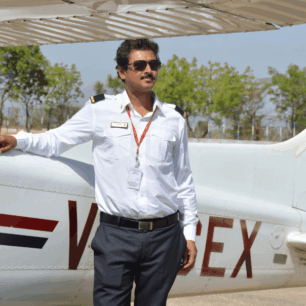
Private Pilot License

IMG_20210722_120124
PRIVATE PILOT LICENSE

PPL TRAINING PROGRAM

Flying a single-engine aircraft – especially if one owns it – is a thrill no words can describe. Not surprisingly, the ranks of individuals who want to earn their private wings and fly for leisure or business is growing exponentially. At Carver Aviation we extend all possible support and cooperation to individuals who want to chase their aviation dream (at any age). The DGCA approved PPL in India allows individuals to fly single-engine aircraft non-commercially – for personal and recreational purposes only. PPL aspirants need to undergo all the theory / ground classes for the technical subjects; as well as successfully complete their flight training, and AELP. Training covers aspects like navigation, meteorology, aerodynamics, radio telephony and aviation law. Once Carver Aviation – India’s most trusted aviation school, with a DGCA approval and an ISO 9001:2015 certification – enables a candidate to bag a PPL, the candidate can boast of their abilities: the necessary knowledge, skills and flight hours to successfully operate single-engine aircrafts.

Courses

Course Summery

Eligibility Criteria to Enroll for a

PPL Program in India

To be eligible to enrol for a PPL program in India, there are certain criteria that must be met. These eligibility criteria ensure that aspiring applicants possess the necessary qualifications and capabilities to undergo flight training and operate an aircraft responsibly.

Following are the key eligibility criteria for enrolling in a PPL program

Age Requirement

- Minimum age for application into a PPL program: 17 years.
- Minimum age for issuance of a PPL licence: 18 years.
These are DGCA mandates - to ensure that an applicant can be considered to have a certain level of maturity required to fly an aircraft, passengers and self with total safety.

Education Requirement

Candidate must have a secondary or equivalent 10th standard pass certificate. There is no % bar nor any entrance exams. Adequate competency in written and spoken English is necessary as all instructions and communication is conducted in English.

Fitness Requirement

Candidate must obtain a Class II Medical Certificate from a DGCA approved medical examiner or form CA 35. Aviation is a physically and mentally demanding field, even as an aspiring pilot you must be in good health to ensure the safety of the aircraft, the passengers and self.
Class II medical exam assesses various aspects of your physical and mental health, including vision, hearing, cardiovascular fitness, and your psychological well-being.

Logistical Details of the PPL Program at Carver Aviation

The PPL Program at Carver Aviation

Once you are enrolled for a PPL at Carver Aviation, you are on your way to becoming a private pilot. The following process outlines the steps to getting you PPL in India:

PPL Program Duration


- Carver Aviation’s PPL Training Program takes 08-10 months to complete, subject to passing DGCA and other exams.

PPL Program Location


- Carver Aviation is strategically located at the Baramati Airport, Baramati. Baramati resides in the rain-shadow region of Maharashtra, this region’s geographic features and weather pattern contribute to year-round safe and efficient flying experiences, while still presenting opportunities to experience and handle challenges like crosswinds and gusty landings.
- Baramati is accessibly by road, rail and air. Baramati Terminus Railway Station allows for easy rail access, Baramati Domestic Airport and Pune International Airport allow for easy air connectivity.

PPL Program Batch Size


- We run 6 PPL training program batches per year, each batch has 4-5 cadets. The classroom strength is deliberately small to ensure appropriate attention to each candidate

PPL Program Type


The PPL Training Program at Carver Aviation is a part time program. We do not offer residential facilities but we help you find suitable accommodation.

Bringing Dreams to Life

PPL Training Program

Ground school training is the first integral branch of any PPL Program. As the name suggests this training predominantly takes place on the ground, in classrooms, in labs, in workshops. Ground school training covers all theoretical subjects required for flying, including but not restricted to aircraft mechanics, air navigation systems, air meteorology, technical general and specific, radio telephony theory and practical, aviation law, communication procedures, human performance and limitations, etc. Ground school lays aviation foundation through the theory of principles of flight, aviation regulations, weather patterns and other crucial aspects of aviation.

Ground Training = minimum 60 hours.

Flight training is the second integral branch of any PPL Program. As the name suggests this training predominantly takes place off the ground and in flights. It includes simulators and aircrafts, dual and solo flights. Simulators have wide views and real-time display of terrains and airports. Dual flight is where you fly an aircraft accompanied by an instructor and solo flights are when you fly alone. All three are mandatory for the completion of this course. During flight training you gain hands-on experience and develop proficiency in controlling an aircraft through various manoeuvres, take-offs, landings, navigation techniques, emergency procedures and other essential flying skills.

Flight Training = minimum 40 hours

Simulator Training = 00 hours for PPL as per DGCA mandate

After completing the training, you need to pass the written and practical exams administered by the DGCA. The written exams assess your theoretical knowledge and understanding of aviation concepts, regulations and procedures while the practical exams assesses your ability to apply your knowledge and skills in a real flight scenario. Successful completion of these exams demonstrates your competence and readiness to be a licensed private pilot.

Written tests for the theory are conducted by the DGCA, in accordance to their published schedule. Flying tests are conducted periodically, according to the student’s schedule, progress is recorded in accordance with DGCA guidelines.

Candidates must obtain both a Class II Medical Certificate from a DGCA approved medical examiner. Aviation is a physically and mentally demanding field. To be able to fly you need to be in good health to ensure the safety of yourself, your passengers, and the aircraft. Class II medical exam assesses various aspects of your physical and mental health, including vision, hearing, cardiovascular fitness, neurological fitness, and your psychological well-being.